
How Big Is a Soccer Field?
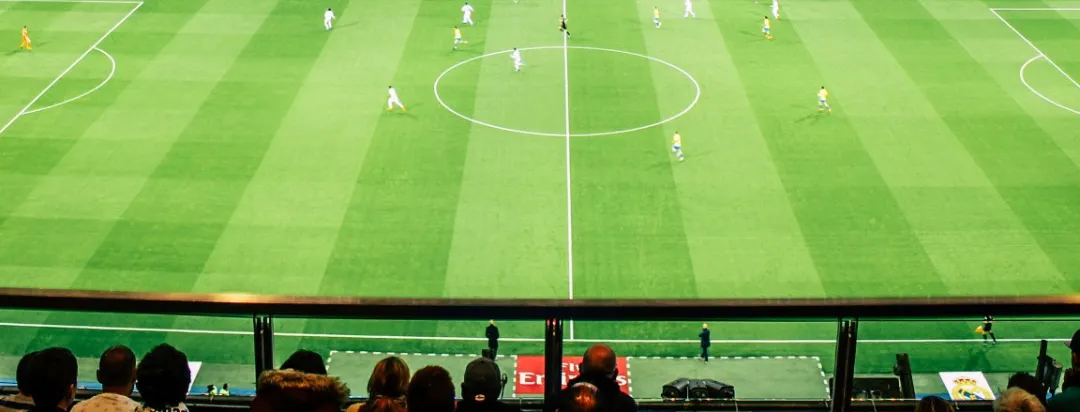
A full-size adult soccer field is 100 to 130 yards long and 50 to 100 yards wide under FIFA's Laws of the Game. International matches require 110 to 120 yards by 70 to 80 yards, and most elite clubs use 115 by 74 yards (105 by 68 meters). Youth fields scale down for developing players.
If you have ever set foot on a soccer pitch, you likely noticed that not all of them feel the same size. There is a reason for that: the Laws of the Game allow a surprising amount of flexibility.
This article breaks down the exact measurements FIFA permits, what professional clubs typically use, and how youth field sizes scale down to suit developing players.
FIFA’s Official Field Dimensions
Under Law 1 of the Laws of the Game, a full-size soccer field for adults must be rectangular and made up of touchlines (the long sides) and goal lines (the short sides).
Acceptable measurements fall within a range rather than one fixed number. The flexibility helps clubs in different climates and stadium configurations meet local needs while still following global rules.
- Length: 100 to 130 yards (90 to 120 meters)
- Width: 50 to 100 yards (45 to 90 meters)
Standard Size for Top-Level Competitions
While FIFA gives a broad range, top-tier competitions adopt a tighter window for consistency and broadcasting needs. For international matches, both men’s and women’s, the field must be 110 to 120 yards long and 70 to 80 yards wide.
Most elite clubs settle on 115 by 74 yards (105 by 68 meters). That dimension appears in many World Cup venues and UEFA Champions League stadiums because it balances space for tactical play and spectator sightlines.
Key Markings and Their Measurements
Beyond the outer rectangle, several internal markings have fixed sizes that never change, regardless of the overall field length or width.
Knowing these measurements can help coaches set up training drills and fans better understand situational play.
- Center circle radius: 10 yards (9.15 meters)
- Goal area: 6 yards (5.5 meters) out from each post and 6 yards into the field
- Penalty area: 18 yards (16.5 meters) out from each post and 18 yards into the field
- Penalty spot: 12 yards (11 meters) from the goal line
- Corner arc radius: 1 yard (1 meter)
How Youth Field Sizes Scale Down
Young players do not use the same colossal space as the pros. Smaller fields encourage more touches on the ball, shorter passes, and less physical strain.
National associations issue their own guidelines, but many follow a common progression as players age.
- U6–U8: roughly 25–35 yards long by 15–25 yards wide
- U9–U10: 55–65 yards long by 35–45 yards wide
- U11–U12: 70–80 yards long by 45–55 yards wide
Soccer Field vs. Other Sports Surfaces
Fans often compare a soccer pitch to an American football field, which measures 120 yards long by 53.3 yards wide including end zones. This means a regulation soccer pitch is wider and, depending on the stadium, can also be longer.
That extra width creates the space wingers and fullbacks need, influencing the free-flowing style that defines the sport.
Surface Materials and Impact on Layout
Whether the pitch is natural grass or modern synthetic turf, the surface does not alter the required dimensions. However, drainage systems, heating coils, and turf panels can dictate how grounds crews paint lines and maintain uniformity.
Stadiums with retractable seating or multi-sport use may choose the minimum international size to accommodate other events without extensive renovations.
The Bottom Line
A soccer field’s size is both flexible and standardized. The outer boundaries can vary within FIFA’s range, yet crucial internal markings remain constant at every level of the game.
Understanding these dimensions adds depth to how we watch, coach, and play the sport, revealing why space management is as vital as skill on the ball.
Gametime Hero is the AI-powered operating system for active communities.
If you're organizing a community and tired of the chaos, start here


